
UCL / Bartlett 100
Celebrating a century of radical thinking—and shaping what comes next.
I led the first faculty-wide, year-long, multi-channel campaign to mark 100 years of The Bartlett, UCL’s Faculty of the Built Environment.
Big idea.
A centenary should do more than look back. For The Bartlett, it was an opportunity to bring together the people, ideas and research that had shaped its first 100 years—and use them to create a shared vision for the next.
The campaign needed to raise the Faculty’s profile and reputation globally, while creating lasting connections across its schools, staff, students, alumni and partners.
Simply told.
I grew and led the communications team, commissioned specialist agencies and brought together every part of the Faculty around one ambitious campaign.
The programme included 100 stories shared through a dedicated digital platform, 100 live events, a participatory exhibition, a commemorative publication, alumni communications and a weekly newsletter. I also delivered the campaign identity, bespoke typeface, branded materials, launch and closing events, and communications for a new scholarship supporting disadvantaged students.
At the centre was the Next 100 Years exhibition, which invited audiences to identify the questions the built environment must answer in the future.
Lasting impact.
The exhibition’s contributions became the basis for a 12-pillar manifesto that informed the Faculty’s future strategy.
The Bartlett 100 publication created the Faculty’s first significant repository of its history, while the campaign connected staff, students, alumni, prospective students and industry around a shared purpose: building a better future.
The campaign microsite attracted 64,580 page views from visitors in 156 countries and 2,186 cities during its first 100 days.
About The Bartlett
To explain what The Bartlett is and where it’s going, a video was commissioned capturing activity across all 12 schools and institutes to give a taste of what happens within the faculty. Video production: Cinematic Pictures.
The dedicated website

Check out full site at bartlett100.com developed by Eggcorn.

Stories were promoted across social media at 8am to hit commuters in the UK and the microsite was designed mobile-first. Each article was given a progress bar as a visual reference to show how much of the article was left, alongside a rough estimated reading time. Image credit: Bartlett100.com
The Next 100 Years Exhibition

An interactive exhibition designed by Boyle&Perks was held in May 2019. It posed the question: ‘What are the most important questions facing the built environment in the next 100 years?’ Photo credit: Ana Escobar.

The boxes could be moved around to help people share the questions they thought were a priority to address and shared on social media. Photo credit: Ana Escobar.

A reading room was set up with a selection of books from academics across the faculty to help form the questions of the future. Photo credit: Ana Escobar.

QR codes on the boxes would take people to the relevant articles on the Bartlett 100 microsite so they could read pieces that interested them. Photo credit: Ana Escobar.

Questions could be submitted physically during the exhibition by sticking it on the wall or via social media, which was displayed on the screen. Photo credit: Manpreet Dhesi.
The Bartlett’s Commitment to Change manifesto


All the responses from the exhibition above were categorised and formed 12 pillars for The Bartlett’s future strategy. The faculty’s focus would be on tackling questions and finding solutions across these areas. Photo credits: Emma Todd.
The Bartlett 100 Publication

A publication was produced of all the 100 stories. Photo credits: Emma Todd.

Given to UCL's libraries, a physical copy of the website for the future.

Copies were given to individuals who contributed.
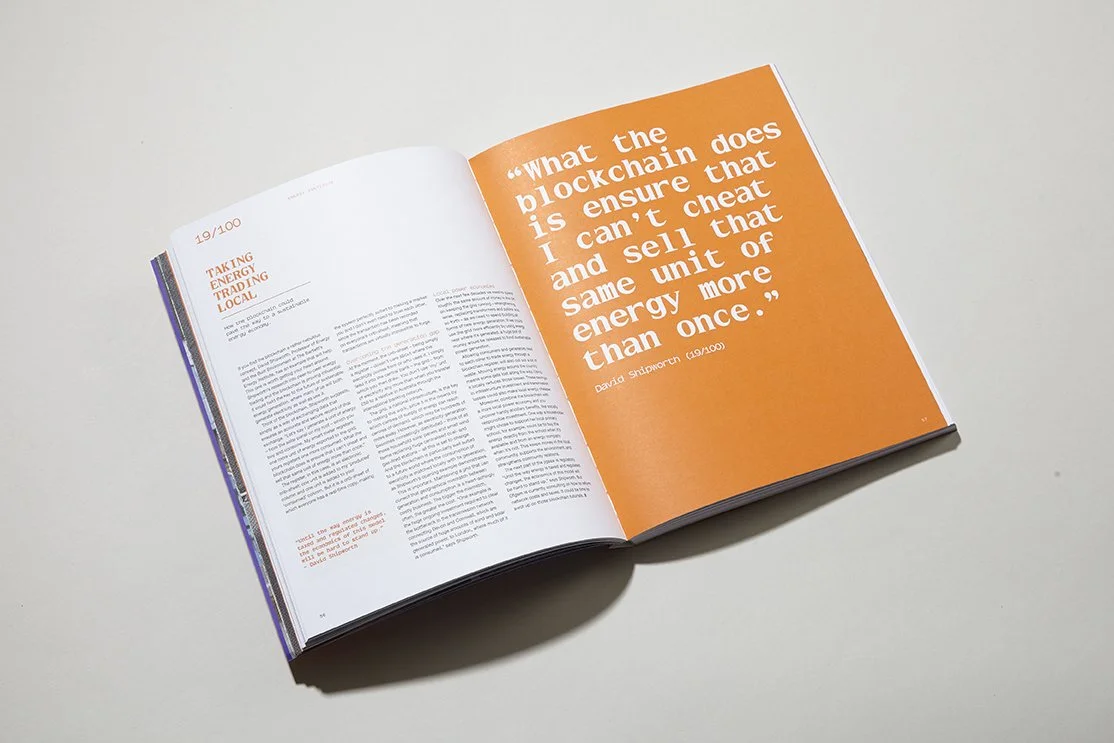
This was The Bartlett’s first carbon-neutral publication.
Bartlett 100 bespoke typeface

A typeface was created by Colophon Foundry for the campaign. The evenly-spaced 12 grid structure was based on the number of Schools and Institutes that made up The Bartlett Faculty. The typeface was story 24 of 100. Image credit: Bartlett100.com.

The fixed-pitch nature of the typeface spoke to the notion that you create within confines. Image credit: Bartlett100.com

The combination of Serif and Sans highlighted the collaborative nature of the faculty. Image credit: Bartlett100.com
Bartlett 100 keepsakes

Flyers to promote the year-long campaign had a poster feel to them. Some were printed to an A2 format and framed. Photo credit: Emma Todd.
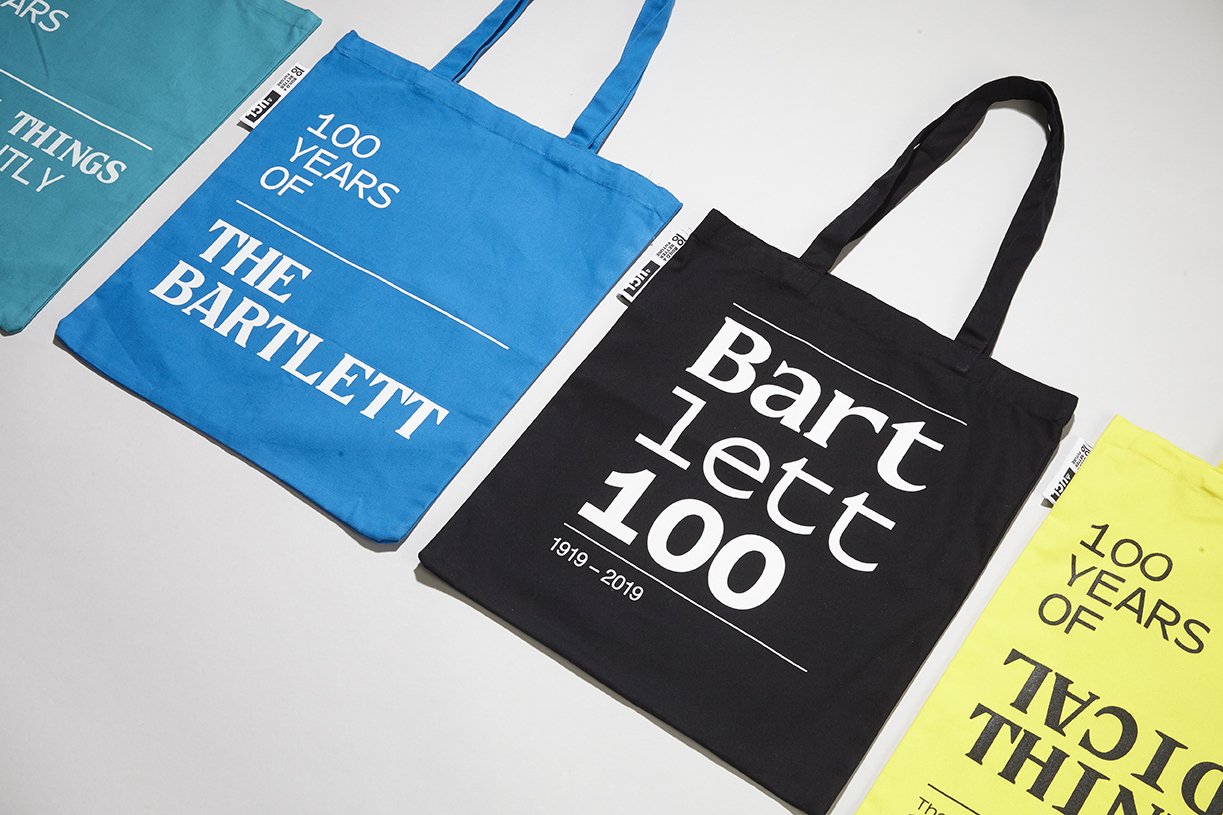
The must-have items of 2019 across UCL, four different types of tote bags were created and over 7,000 were given away. Photo credit: Emma Todd.

Pencils and notebooks were produced with the campaign’s identity (designed by Eggcorn) and distributed across the year at key Bartlett 100 events. Photo credit: Emma Todd.

Sent to all prospective students who held an offer to study at The Bartlett, a newspaper showcasing the campaign and event to encourage conversion. Photo credit: Emma Todd.
The launch and closing events

A launch event held at The Bartlett’s 22 Gordon Street location. A closed event for the Dean to say thank you to those who had helped deliver some of the biggest projects for the faculty across the 10-years under his leadership and to officially launch the campaign. Photo credit: Richard Stonehouse.

A 3D foam model of the identity of the campaign highlighted the 100 stories. Photo credit: Richard Stonehouse.

Event 100 of 100, a closing event to round up the year open to all staff and students across the faculty. Copies of the Bartlett 100 book were available to take away for free. The event was held across the top floor of 22 Gordon Street and attendees were free to explore The Bartlett School of Architecture’s Winter Show, which was on display across all the landings and ground floor. Photo credit: Manpreet Dhesi.
“Manpreet delivers. An amazing capacity to think things through, to develop a strategy, commission the services needed and make a communications programme just happen. A brilliant colleague and a real pleasure to work with.”
–Alan Penn, previous Dean of The Bartlett
I was employed by UCL while working on this project. This is indicative of the projects I can deliver through the studio or consulting service.